Manually open a sectional door with Secure, Smart or Smart Pro
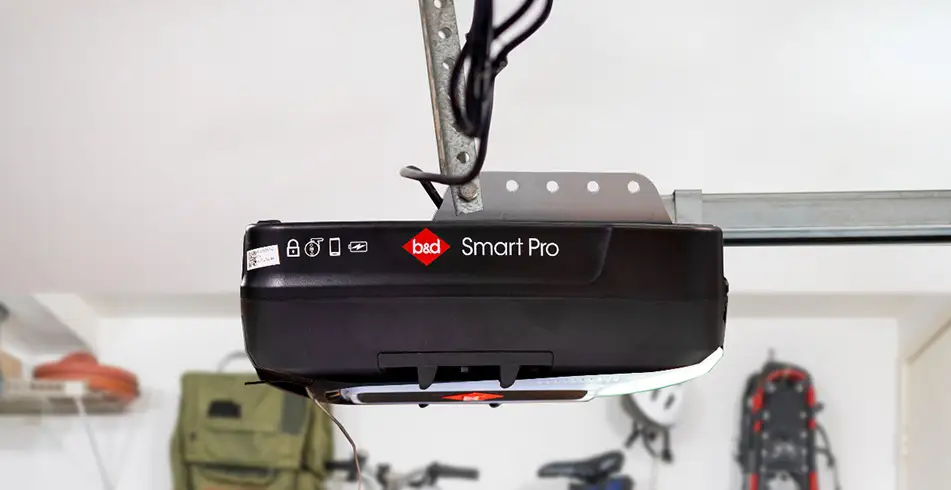
Power out? We’ll show you how to disengage and reconnect a Secure SDO-6V3, Smart SDO-7V3 or Smart Pro SDO-9V3 so you can use a sound sectional door by hand. Start with the door closed and check any separate lock. If the door is damaged, unbalanced or unsupported, stop and arrange help.
Urgent repair help · Call 13 62 63
Check the exact model and mechanism
Applies to Secure SDO-6V3, Smart SDO-7V3 and Smart Pro SDO-9V3. Check the model/version label and match the controls to the linked manual before starting. A familiar product name or remote appearance alone does not establish compatibility.
This procedure does not cover every older B&D opener, PanelMax, commercial operator or gate motor. Use the instructions for that exact model. Roll-A-Door Secure and installations with an automatic lock also need their separate lock/system procedure.
When not to use manual release
Stop if the door is damaged, crooked, unusually heavy or has a broken spring or cable. Keep people and vehicles clear and arrange a repair. Do not release an open or unsupported door, pull it back onto its tracks or adjust springs, cables or opener force settings.
The manuals recommend disengaging with the door closed. An open door can fall rapidly if springs are weak or broken or the door is unbalanced. If the door is stuck open or partly open, ask a technician to assess it before releasing the drive.
Check separate locks first
A separate lock must be dealt with using its own instructions. Do not use motor force or manual lifting to overcome an engaged lock. Sectional AUTO LOCK and Roll-A-Door Secure are different systems; releasing the opener does not prove their locks have released.
Sectional AUTO LOCK operation · Roll-A-Door Secure system information
Disengage and move the door manually
- Confirm the door is sound and closed, with people, vehicles and objects out of its travel path. Identify the release handle shown in your model’s manual.
- Pull the release handle towards the garage door, as shown in the rail diagram, until you hear the click.
- Use the door’s intended lifting handle to move it by hand, keeping control of it. Do not use the release cord to lift or lower the door. Keep fingers clear of panel joints, tracks and moving parts.
- Stop if movement is heavy, uneven, jammed or unexpected. Do not force the door or try to adjust its springs.
While disengaged, your opener no longer locks the door. Keep control of access: closing the door by hand does not secure it through the opener.
Close and re-engage
- Carefully close the sound door by hand, keeping the opening clear.
- Pull the release handle away from the garage door until you hear the click, as shown in the rail diagram.
- When power is available, stand clear and use a programmed remote while watching the door to check normal operation. Confirm the door actually moves with the drive and closes correctly.
- If the motor runs but the door does not move, or engagement remains uncertain, stop and arrange assistance. Do not treat a click alone as proof the complete system is secure.
If the release will not operate
Do not tug harder, add leverage or dismantle the mechanism. Ask us to identify the installation if the handle, direction or response differs. A garage without another entrance needs an appropriate external access arrangement; do not try to force entry through the door.
If the controls, indicators or release mechanism differ from this guide, stop and find your model’s manual or call us on 13 62 63. Have the opener model/version, remote or accessory model and the symptom ready. For damage or repeated faults, arrange a repair.
Your manuals and helpful downloads
- SDO-6V3 / 7V3 / 9V3 manual: section 17, page 19
- Sectional Quick Operation Guide: manual operation
- Sectional AUTO LOCK Quick Operation Guide — separate lock procedure
- More from B&D
Keep the guide for the model and equipment fitted to your garage. The documents below include the diagrams, full warnings and installer information to support the steps above.
Images on This Page
-
https://api.fouanalytics.com/api/noscript-2080i4coynpv51kq7epl.gif
(no alt text)
-
https://admin.bnd.com.au/media/kvqhfp5m/bd_80years-logo_2026_dark.png?rmode=max&width=2212&height=722
(no alt text)
-
https://admin.bnd.com.au/media/zdmj44kf/showrooms.svg
bnd-showrooms
-
https://admin.bnd.com.au/media/k2bhaqq2/bd-roll-a-door-night-sky-inside.webp?rmode=max&width=0&height=0
Reliable as Can B&D Roll-A-Door Garage Door Interior in Night Sky
-
https://admin.bnd.com.au/media/iigb25uj/bd-panelift-icon-basalt-nullabor.webp?rmode=max&width=0&height=0
Safe as Can B&D Panelift Section Door in Nullabor Basalt
-
https://admin.bnd.com.au/media/2jombqn1/bnd-designer-finishes-sheer-panel.webp?rmode=max&width=4546&height=2564
Bnd-Designer-Finishes-Sheer-Panel
-
https://admin.bnd.com.au/media/0fel4abo/bd-roll-a-door-series-2-commercial-warehouse-forklift.webp?rmode=max&width=951&height=490
Safe as Can B&D Forklift in front of a Series 2 Commercial Roller Door Home
-
https://admin.bnd.com.au/media/m1bpjbhm/bd-toughpanel-commercial-sectional-door.webp?rmode=max&width=1308&height=797
(no alt text)
-
https://admin.bnd.com.au/media/iukar1yo/bd-roll-a-door-series2-commercial-door.webp?rmode=max&width=951&height=490
Safe as Can B&D Angled view of Series 2 commercial Roll-A-Door installed in warehouse Home
-
https://admin.bnd.com.au/media/tt4na5tf/bd-controll-a-door-power-drive-roller-door-opener-profile.webp?rmode=max&width=0&height=0
Reliable as Can B&D Controll-A-Door Power Drive Opener Profile
-
https://admin.bnd.com.au/media/3k3b2sqk/bd-smart-pro-sectional-door-opener-profile-5.webp?rmode=max&width=0&height=0
Smart as Can B&D Profile View of Smart Pro Sectional Door Opener
-
https://admin.bnd.com.au/media/yxbf3xdh/bd-garage-door-remote.webp?rmode=max&width=0&height=0
Safe as Can B&D Two Branded Garage Door Remotes
-
https://admin.bnd.com.au/media/l52nemhn/bd-garage-door-smartphone-control.webp?rmode=max&width=0&height=0
Smart as Can B&D Hand holding smartphone in front of house and garage
-
https://admin.bnd.com.au/media/pfqjekdd/bd-auto-lock-garage-doors.webp?rmode=max&width=0&height=0
Safe as Can B&D Garage Door AUTO LOCK™
-
https://admin.bnd.com.au/media/bifpraoy/bd-safety-beam.webp?rmode=max&width=951&height=490
Safe as Can B&D Infrared Safety Beam Home
-
https://admin.bnd.com.au/media/scggu1y0/bd-controll-a-door-secure-sectional-door-opener-profile-5.webp?rmode=max&width=0&height=0
Safe as Can B&D Controll-A-Door Secure Door Opener Profile
-
https://admin.bnd.com.au/media/mswbsv20/social_facebook.webp?rmode=max&width=0&height=0
facebook social
-
https://admin.bnd.com.au/media/1mdhluow/social_youtube.webp?rmode=max&width=0&height=0
youtube social
-
https://admin.bnd.com.au/media/b5ukqdzp/social_linkedin.webp?rmode=max&width=0&height=0
linkedin social
-
https://admin.bnd.com.au/media/0hxb2b1k/bd-garage-doors-pinterest.webp?rmode=max&width=0&height=0
Pinterest Logo
-
https://admin.bnd.com.au/media/xyhfahvw/instagram-64.webp?rmode=max&width=0&height=0
instagram social
-
https://admin.bnd.com.au/media/dixfjpl4/branding_dulux.webp?rmode=max&width=0&height=0
Dulux page
-
https://admin.bnd.com.au/media/2c0jsrqw/asial-australian-security-industry-association-limited-member-logo.webp?rmode=max&width=0&height=0
ASIAL Australian Security Industry Association Limited Member Logo
-
https://www.bnd.com.au/images/app-store-badge.svg
Download on the App Store
-
https://www.bnd.com.au/images/google-play-badge.svg
Get it on Google Play
-
https://pixel.zprk.io/v5/pixel/ok5dCCY8BD.gif?ssid=1
(no alt text)